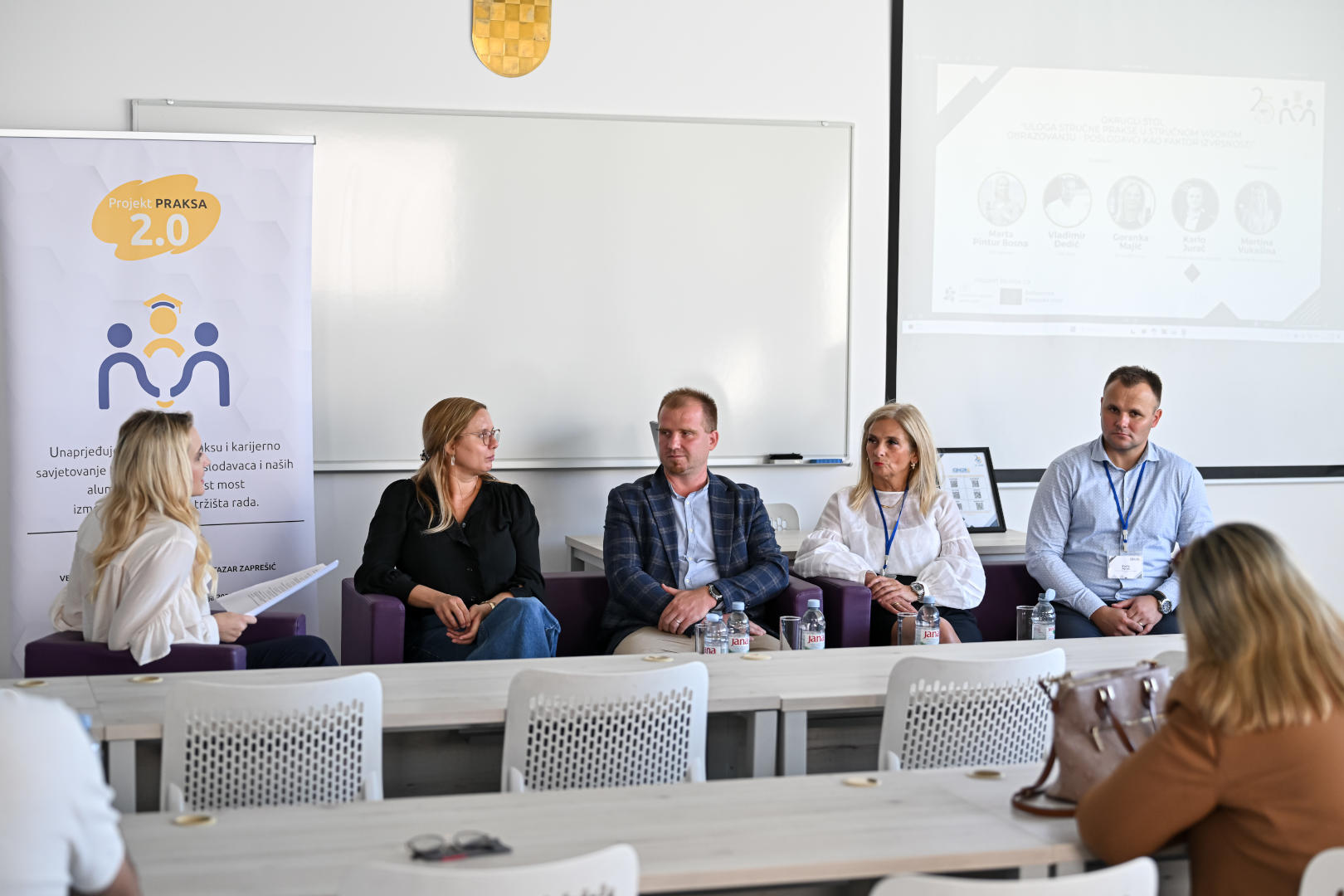
Praksa 2.0
ESF+ Učinkoviti ljudski potencijali
Sufinancirala Europska unija

Projekt Praksa 2.0

O projektu

Korisnik: Veleučilište Baltazar Zaprešić

Trajanje projekta: od 23. lipnja 2026. do 23. lipnja 2029.

Ukupan proračun projekta: 331.835,82 €

Izvor financiranja:
– Operativni program “Učinkoviti ljudski potencijali 2021. – 2027.”
– Europski socijalni fond +

Opis projekta

Projektom Praksa 2.0 ojačat će se kapaciteti Veleučilišta Baltazar Zaprešić za povećanje zapošljivosti studenata, odnosno diplomanata, a kroz unaprijeđenu kvalitetu stručne prakse, evaluaciju provedene stručne prakse te razvijene djelatnosti karijernog savjetovanja. Studenti završnih godina svih studijskih programa Veleučilišta Baltazar Zaprešić unaprijedit će svoje praktične vještine uz mentoriranje nastavnika mentora i mentora poslodavaca. U provedbu će biti uključeni i poslodavci koji će aktivno sudjelovati u evaluaciji stručne prakse te unapređenju ishoda učenja stručne prakse, u svrhu usklađivanja praktičnih vještina stečenih obrazovanjem i vještina potrebnih na tržištu rada. Rezultat provedbe projekta manifestirat će se kroz veću zapošljivost diplomiranih studenata Veleučilišta Baltazar Zaprešić.

Aktivnosti projekta
  • A1 Provedba stručne prakse za studente upisane na visoka učilišta kod poslodavca – provedba
    prakse kod poslodavaca/MSP
  • A2 Evaluacija provedene stručne prakse – evaluacija SP na pojedinom studijskom programu
  • A3 Provođenje djelatnosti karijernog savjetovanja studenata i osnivanja/širenja alumni zajednice na visokom učilištu
  • A4 Osmišljavanje, unapređenje i provedba ostalih oblika stjecanja praktičnih vještina predviđenih ishodima učenja studijskog programa
PROJEKTNI TIM

1. izv. prof. dr. sc. Ivan Ružić

2. dr. sc. socio. Ivana Lacković

3. doc. dr. sc. Martina Vukašina

4. dr. sc. socio. Kristijan Čović

5. prof. dr. sc. Drago Ružić

6. doc. dr. sc. Zlatko Barilović

7. doc. dr. sc. Maja Buljat

8. dr. sc. socio. Ivana Cunjak Mataković

9. dr. sc. Sendi Deželić

10. dr. sc. Alisa Bilal Zorić

11. dr. sc. Ninoslav Gregurić-Bajza

12. dr. sc. Ana Skledar Ćorluka

13. doc. dr. sc. Daša Panjaković Senjić

14. dr. sc. Goran Jelen

15. dr. sc. Lana Domšić

16. mr. sc. Ines Jemrić Ostojić

17. Krešimir Jurina, struč. spec. ing. techn. inf. et. mag. oec.

18. Ljiljana Nekić, mag. oec.

19. Karlo Jurač, mag. oec.

EDITORIAL BORD

  • Ivan Ružić, University of Applied Sciences Baltazar Zaprešić, Croatia;
  • Antal Balog, University of Applied Sciences Baltazar Zaprešić, Croatia;
  • Tihomir Vranešević, University of Applied Sciences Baltazar Zaprešić, Croatia;
  • Sandra Mrvica Mađarac, College of Applied Sciences Lavoslav Ružička in Vukovar, Croatia;
  • Marija Bečić, University of Dubrovnik, Faculty of Economics and Business, Croatia;
  • Marija Dragičević, University of Dubrovnik, Faculty of Economics and Business, Croatia;
  • Ivona Vrdoljak Raguž, University of Dubrovnik, Faculty of Economics and Business, Croatia;
  • Davor Vašiček, University of Rijeka, Faculty of Economics and Business, Croatia;
  • Irena Pandža Bajs, University of Zagreb, Faculty of Economics and Business, Croatia;
  • Mirjana Hladika, University of Zagreb Faculty of Economics and Business, Croatia;
  • Iva Gregurec. University of Zagreb Faculty of Organization and Informatics, Croatia;
  • Valentin Vasilev, New Bulgarian University, Bulgaria;
  • Dafinka Sidova, New Bulgarian University, Department of National and International Security, Bulgaria;
  • Rainer Hasenauer, Vienna University of Economics and Business, Austria;
  • Chaido Dritsaki, International Hellenic University, School of Economics and Business Administration, Greece;
  • Dimitra Scandali, University of the Peloponnese, Department of Economics, Greece;
  • Mitsunori Hirogaki, Kyushu University, Faculty of Economics, Japan;
  • Monika Arsova, Goce Delcev University, Faculty of Economics, Republic of North Macedonia;
  • Ivan Efremovski, International Slavic University Sveti Nikole, Republic of North Macedonia;
  • Ewelina Idziak, Kazimierz Wielki University, Faculty of Law and Economics, Poland;
  • Agnieszka Małkowska, University of Szczecin, Faculty of Economics, Finance and Management, Poland;
  • Olga Martyniuk, University of Gdańsk, Faculty of management, Poland;
  • Priya Solomon, Universal AI University, India; V. Bastin Jerome, St. Joseph’s College (Autonomous), Department of Commerce Honours, India;
  • Senapathy Marisennayya, Wolaita Sodo University, Department of Rural Development and Agricultural Extension, Ethiopia;
  • Catalin Popescu, Petroleum-Gas University of Ploiesti, Romania;
  • Dimitrina Stefanova, South-West University “Neofit Rilski”, Bulgaria;
  • Otilija Sedlak, University of Novi Sad, Faculty of Economics in Subotica, Serbia;
  • Hasibe Aysan, OSTIM Technical University, Faculty of Economics and Administrative Sciences, Turkey;
  • Katerina Pavlou, Cyprus Business School, Cyprus;

The International Journal of Multidisciplinarity in Business and Science (IJMBS) publishes high-quality scientific and professional contributions in the fields of business, economics, management, social sciences, and interdisciplinary research. The journal welcomes original scientific papers, review articles, professional papers, conceptual papers, case studies, and other scholarly contributions relevant to its scope.

IJMBS applies a double-blind peer review process in which the identities of both authors and reviewers remain confidential throughout the review procedure.

Before completing the Review Form, reviewers are kindly requested to consider the evaluation criteria outlined below. These guidelines are intended to support the preparation of constructive, objective, and comprehensive review comments and recommendations.

I REVIEW CRITERIA

When reviewing a manuscript, please consider the following aspects:

  • Relevance, clarity, and conciseness of the title;
  • Clarity and definition of the research objectives;
  • Relevance, significance, and timeliness of the research topic;
  • Structure, organization, and logical flow of the manuscript;
  • Clarity, readability, and linguistic quality of the manuscript;
  • Adequacy and relevance of the theoretical and conceptual framework;
  • Appropriateness and rigor of the research methodology;
  • Quality, reliability, and interpretation of data, results, or findings;
  • Originality, novelty, and scientific contribution of the manuscript;
  • Adequacy, relevance, and currency of the cited literature;
  • Consistency between results and conclusions;
  • Quality and usefulness of tables, figures, graphs, and appendices;
  • Theoretical and practical implications of the study;
  • Suggestions for improvements, revisions, or corrections;
  • Overall suitability of the manuscript for publication in IJMBS.


Reviewers are encouraged to provide clear, detailed, and constructive comments that will assist authors in improving the quality and scientific contribution of their manuscripts.

II ARTICLE CLASSIFICATION

Based on the reviewers’ recommendations, manuscripts may be classified into one of the following categories:

Original Scientific Paper

A manuscript presenting original research findings that significantly contribute to scientific knowledge and have not been previously published.

Preliminary Communication

A manuscript presenting new and relevant scientific findings that merit rapid dissemination before the completion of more comprehensive research.

Review Article

A manuscript providing a critical, systematic, and comprehensive review of existing literature, theories, concepts, and developments within a specific field of study.

Professional Paper

A manuscript presenting professional experiences, practical applications, analyses, or solutions relevant to professional practice without necessarily containing original scientific research.

III REVIEW RECOMMENDATION

After completing the evaluation, reviewers are requested to provide one of the following recommendations:

  • Accept without revisions;
  • Accept with minor revisions;
  • Accept after major revisions;
  • Reject.


The final publication decision is made by the Editorial Board based on the reviewers’ reports and recommendations.

IV ETHICAL RESPONSIBILITIES OF REVIEWERS

Reviewers play a crucial role in maintaining the quality, credibility, and integrity of the scientific publication process. By accepting a review assignment, reviewers agree to adhere to the following ethical principles:

Confidentiality

All manuscripts received for review must be treated as confidential documents. Reviewers must not share, distribute, discuss, or use any information contained in the manuscript for personal, professional, or research purposes before publication.

Objectivity and Fairness

Reviews should be conducted objectively, professionally, and without personal criticism of the author(s). Assessments should be based solely on the scientific merit, originality, methodology, clarity, and relevance of the manuscript.

Conflict of Interest

Reviewers should decline the review assignment if they have any actual or potential conflict of interest arising from personal, institutional, academic, collaborative, or financial relationships with the authors, organizations, or institutions associated with the manuscript.

Identification of Ethical Issues

Reviewers are encouraged to notify the Editorial Board if they identify potential ethical concerns, including plagiarism, duplicate publication, data fabrication, data falsification, inappropriate authorship practices, citation manipulation, or any other form of scientific misconduct.

Timeliness

Reviewers should complete their evaluations within the agreed timeframe. If circumstances prevent timely completion of the review, reviewers should promptly inform the Editorial Office.

Use of Artificial Intelligence Tools

To protect confidentiality and intellectual property, reviewers must not upload manuscripts or any part of a manuscript to generative artificial intelligence tools or external systems that may store, process, or disclose manuscript content. Any use of AI-assisted tools must not replace the reviewer’s independent scientific judgment and critical evaluation.

V REVIEW PROCESS

Each manuscript submitted to IJMBS undergoes an initial editorial assessment to determine its suitability for the journal’s scope and compliance with the journal’s submission requirements. Manuscripts that pass the initial screening are sent to at least two independent reviewers.

The review process follows the principles of double-blind peer review, ensuring that neither the authors nor the reviewers are aware of each other’s identities. Based on the reviewers’ reports, the Editorial Board may decide to accept the manuscript, request revisions, or reject the submission.

Authors may be requested to revise their manuscripts in accordance with reviewers’ comments. Revised manuscripts may be returned to the reviewers for additional evaluation when necessary.

VI ACKNOWLEDGEMENT

The Editorial Board of IJMBS sincerely appreciates the valuable contribution of reviewers. Through their expertise, professionalism, and commitment, reviewers help ensure the scientific quality, integrity, and continuous development of the journal.

By accepting a review invitation, reviewers confirm that they will conduct the review in accordance with the highest standards of academic integrity, confidentiality, impartiality, and professional ethics.

Karlo Jurač, voditelj projekta

karlo.jurac@bak.hr

EDITORIAL BORD

  • Ivan Ružić, University of Applied Sciences Baltazar Zaprešić, Croatia;
  • Antal Balog, University of Applied Sciences Baltazar Zaprešić, Croatia;
  • Tihomir Vranešević, University of Applied Sciences Baltazar Zaprešić, Croatia;
  • Sandra Mrvica Mađarac, College of Applied Sciences Lavoslav Ružička in Vukovar, Croatia;
  • Marija Bečić, University of Dubrovnik, Faculty of Economics and Business, Croatia;
  • Marija Dragičević, University of Dubrovnik, Faculty of Economics and Business, Croatia;
  • Ivona Vrdoljak Raguž, University of Dubrovnik, Faculty of Economics and Business, Croatia;
  • Davor Vašiček, University of Rijeka, Faculty of Economics and Business, Croatia;
  • Irena Pandža Bajs, University of Zagreb, Faculty of Economics and Business, Croatia;
  • Mirjana Hladika, University of Zagreb Faculty of Economics and Business, Croatia;
  • Iva Gregurec. University of Zagreb Faculty of Organization and Informatics, Croatia;
  • Valentin Vasilev, New Bulgarian University, Bulgaria;
  • Dafinka Sidova, New Bulgarian University, Department of National and International Security, Bulgaria;
  • Rainer Hasenauer, Vienna University of Economics and Business, Austria;
  • Chaido Dritsaki, International Hellenic University, School of Economics and Business Administration, Greece;
  • Dimitra Scandali, University of the Peloponnese, Department of Economics, Greece;
  • Mitsunori Hirogaki, Kyushu University, Faculty of Economics, Japan;
  • Monika Arsova, Goce Delcev University, Faculty of Economics, Republic of North Macedonia;
  • Ivan Efremovski, International Slavic University Sveti Nikole, Republic of North Macedonia;
  • Ewelina Idziak, Kazimierz Wielki University, Faculty of Law and Economics, Poland;
  • Agnieszka Małkowska, University of Szczecin, Faculty of Economics, Finance and Management, Poland;
  • Olga Martyniuk, University of Gdańsk, Faculty of management, Poland;
  • Priya Solomon, Universal AI University, India; V. Bastin Jerome, St. Joseph’s College (Autonomous), Department of Commerce Honours, India;
  • Senapathy Marisennayya, Wolaita Sodo University, Department of Rural Development and Agricultural Extension, Ethiopia;
  • Catalin Popescu, Petroleum-Gas University of Ploiesti, Romania;
  • Dimitrina Stefanova, South-West University “Neofit Rilski”, Bulgaria;
  • Otilija Sedlak, University of Novi Sad, Faculty of Economics in Subotica, Serbia;
  • Hasibe Aysan, OSTIM Technical University, Faculty of Economics and Administrative Sciences, Turkey;
  • Katerina Pavlou, Cyprus Business School, Cyprus;

Novosti o projektu