Veleučilište Baltazar Zaprešić od akademske godine 2023./2024. izvodi online nastavu na stručnim prijediplomskim te stručnim diplomskim studijima!


Submissions are now open.
Submission deadline: 30. September 2026.
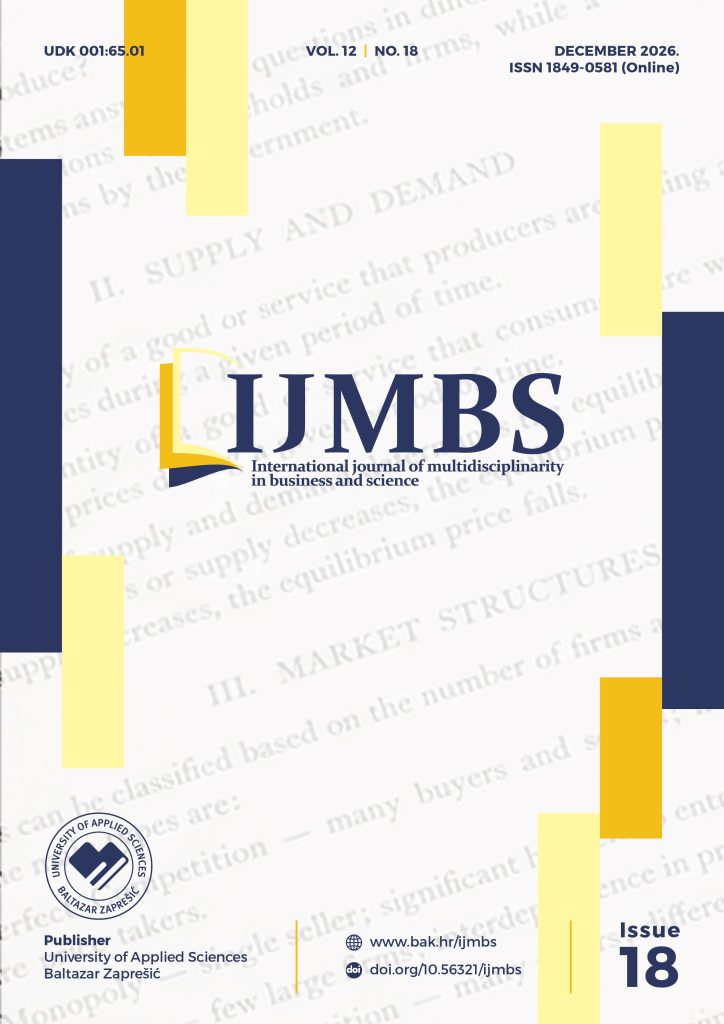
The International Journal of Multidisciplinarity in Business and Science (IJMBS) is an international peer-reviewed open access journal published by Veleučilište Baltazar Zaprešić. The journal publishes original scientific and professional contributions in business, economics, management, social sciences, and interdisciplinary research, fostering international collaboration and the exchange of knowledge.
The International Journal of Multidisciplinarity in Business and Science (IJMBS) is an international peer-reviewed open access scientific journal published by Veleučilište Baltazar Zaprešić. The journal provides a platform for researchers, academics, professionals, and practitioners to publish original scientific and professional papers in the fields of business, economics, management, social sciences, interdisciplinary studies, and related scientific disciplines.
IJMBS promotes multidisciplinary and international approaches to contemporary scientific and professional challenges, encouraging cooperation between academia, industry, public institutions, and the wider community. The journal aims to support the exchange of knowledge, innovative ideas, and research results that contribute to scientific development and practical application.
The journal publishes original scientific papers, review papers, professional papers, case studies, and conference-related contributions. All submitted manuscripts undergo a double-blind peer review process to ensure scientific quality, originality, and academic integrity.
IJMBS is committed to the principles of open access publishing, publication ethics, transparency, and international academic cooperation. The journal welcomes contributions from authors worldwide and seeks to strengthen its international visibility and scientific relevance through continuous development and inclusion in recognized international indexing databases.
Scientific and professional research in business, economics, management, social sciences, and interdisciplinary fields. The journal encourages innovative, multidisciplinary approaches that connect theory and practice and address contemporary societal and organizational challenges
The International Journal of Multidisciplinarity in Business and Science (IJMBS) aims to promote high-quality scientific and professional research through an interdisciplinary and multidisciplinary approach connecting business, economics, management, social sciences, and related scientific fields.
The journal welcomes theoretical, empirical, and applied research based on quantitative and qualitative methods, including empirical studies, conceptual and methodological papers, comparative analyses, case studies, and critical literature reviews. Particular attention is given to research that integrates different scientific and professional perspectives, connects theory and practice, and contributes to a better understanding of contemporary economic, organizational, technological, and societal challenges.
IJMBS encourages multidisciplinary research relevant to academia, business practice, institutions, policymakers, and the wider scientific and professional community, with the aim of supporting the exchange of knowledge, innovative ideas, and practical insights in contemporary business and society.
EDITOR IN CHIEF
Tanja Gavrić, University of Applied Sciences Baltazar Zaprešić, Croatia
ASSOCIATE EDITOR
Sendi Deželić, University of Applied Sciences Baltazar Zaprešić, Croatia
EXECUTIVE EDITORS
Maja Buljat, University of Applied Sciences Baltazar Zaprešić, Croatia
Ana Skledar Ćorluka, University of Applied Sciences Baltazar Zaprešić, Croatia
TECHNICAL EDITOR
Damir Vidaković, University of Applied Sciences Baltazar Zaprešić, Croatia
EDITORIAL BORD
The reviewer guidelines provide information on manuscript assessment, review criteria, ethical responsibilities, and editorial recommendations. They are designed to support a fair, objective, and transparent double-blind peer review process and to ensure the scientific quality of published research.
The International Journal of Multidisciplinarity in Business and Science (IJMBS) publishes high-quality scientific and professional contributions in the fields of business, economics, management, social sciences, and interdisciplinary research. The journal welcomes original scientific papers, review articles, professional papers, conceptual papers, case studies, and other scholarly contributions relevant to its scope.
IJMBS applies a double-blind peer review process in which the identities of both authors and reviewers remain confidential throughout the review procedure.
Before completing the Review Form, reviewers are kindly requested to consider the evaluation criteria outlined below. These guidelines are intended to support the preparation of constructive, objective, and comprehensive review comments and recommendations.
I REVIEW CRITERIA
When reviewing a manuscript, please consider the following aspects:
Reviewers are encouraged to provide clear, detailed, and constructive comments that will assist authors in improving the quality and scientific contribution of their manuscripts.
II ARTICLE CLASSIFICATION
Based on the reviewers’ recommendations, manuscripts may be classified into one of the following categories:
Original Scientific Paper
A manuscript presenting original research findings that significantly contribute to scientific knowledge and have not been previously published.
Preliminary Communication
A manuscript presenting new and relevant scientific findings that merit rapid dissemination before the completion of more comprehensive research.
Review Article
A manuscript providing a critical, systematic, and comprehensive review of existing literature, theories, concepts, and developments within a specific field of study.
Professional Paper
A manuscript presenting professional experiences, practical applications, analyses, or solutions relevant to professional practice without necessarily containing original scientific research.
III REVIEW RECOMMENDATION
After completing the evaluation, reviewers are requested to provide one of the following recommendations:
The final publication decision is made by the Editorial Board based on the reviewers’ reports and recommendations.
IV ETHICAL RESPONSIBILITIES OF REVIEWERS
Reviewers play a crucial role in maintaining the quality, credibility, and integrity of the scientific publication process. By accepting a review assignment, reviewers agree to adhere to the following ethical principles:
Confidentiality
All manuscripts received for review must be treated as confidential documents. Reviewers must not share, distribute, discuss, or use any information contained in the manuscript for personal, professional, or research purposes before publication.
Objectivity and Fairness
Reviews should be conducted objectively, professionally, and without personal criticism of the author(s). Assessments should be based solely on the scientific merit, originality, methodology, clarity, and relevance of the manuscript.
Conflict of Interest
Reviewers should decline the review assignment if they have any actual or potential conflict of interest arising from personal, institutional, academic, collaborative, or financial relationships with the authors, organizations, or institutions associated with the manuscript.
Identification of Ethical Issues
Reviewers are encouraged to notify the Editorial Board if they identify potential ethical concerns, including plagiarism, duplicate publication, data fabrication, data falsification, inappropriate authorship practices, citation manipulation, or any other form of scientific misconduct.
Timeliness
Reviewers should complete their evaluations within the agreed timeframe. If circumstances prevent timely completion of the review, reviewers should promptly inform the Editorial Office.
Use of Artificial Intelligence Tools
To protect confidentiality and intellectual property, reviewers must not upload manuscripts or any part of a manuscript to generative artificial intelligence tools or external systems that may store, process, or disclose manuscript content. Any use of AI-assisted tools must not replace the reviewer’s independent scientific judgment and critical evaluation.
V REVIEW PROCESS
Each manuscript submitted to IJMBS undergoes an initial editorial assessment to determine its suitability for the journal’s scope and compliance with the journal’s submission requirements. Manuscripts that pass the initial screening are sent to at least two independent reviewers.
The review process follows the principles of double-blind peer review, ensuring that neither the authors nor the reviewers are aware of each other’s identities. Based on the reviewers’ reports, the Editorial Board may decide to accept the manuscript, request revisions, or reject the submission.
Authors may be requested to revise their manuscripts in accordance with reviewers’ comments. Revised manuscripts may be returned to the reviewers for additional evaluation when necessary.
VI ACKNOWLEDGEMENT
The Editorial Board of IJMBS sincerely appreciates the valuable contribution of reviewers. Through their expertise, professionalism, and commitment, reviewers help ensure the scientific quality, integrity, and continuous development of the journal.
By accepting a review invitation, reviewers confirm that they will conduct the review in accordance with the highest standards of academic integrity, confidentiality, impartiality, and professional ethics.

IJMBS is committed to the highest standards of publication ethics, research integrity, transparency, and responsible scholarly publishing. The journal follows ethical principles for authors, reviewers, editors, and publishers to ensure the quality and credibility of published research.
International Journal of Multidisciplinarity in Business and Science – (IJMBS) is the scientific journal of UNIVERSITY OF APPLIED SCIENCES BALTAZAR ZAPREŠIĆ
Aiming to improve the overall quality of the journal, the publisher has established these guidelines:
EDITOR
Improving Publication Ethics
The editor will actively seek the views of authors, readers, reviewers, the editorial board and editorial advisory board members about ways of improving the journal. The editor will support initiatives to reduce academic misconduct and to educate researchers about publication ethics. Journal policies will be revised if required, taking into account the new findings in the field of journalology and the effects of journal policies on authors’ and reviewers’ behaviour.
Publication Decisions
The editor is responsible for deciding which of the articles submitted to the journal should be published. Decisions are driven by quality and the importance of the article to researchers and readers. In making decisions the editor may consult reviewers, the editorial board and the editorial advisory board members.
Fair Play
The editor evaluates manuscripts for their intellectual content without regard to the race, gender, sexual orientation, religious belief, ethnic origin, citizenship, or political philosophy of the authors. Submissions to the journal authored by the editor, the employees of the publisher or the editorial board and editorial advisory board members will be handled in such way as to ensure unbiased reviews.
Disclosure and Conflicts of Interest
Confidentiality
The editor and the editorial staff must not disclose any information about a submitted manuscript to anyone other than the corresponding author, reviewers, potential reviewers, other editorial advisers, and the publisher, as appropriate.
Involvement and Cooperation in Investigations
The editor should take reasonably responsive measures when ethical complaints have been presented concerning a submitted manuscript or published paper, in conjunction with the publisher. Such measures will generally include contacting the authors of the manuscript or published paper and giving due consideration to the respective complaint or claims made, but may also include further communications to the relevant institutions and research bodies, and if the complaint is upheld, the publication of a correction, retraction, expression of concern, or other note, as may be relevant. Every reported act of unethical publishing behaviour must be looked into, even if it is discovered years after publication.
THE EDITORIAL BOARD
The publisher will establish a suitably qualified editorial board and editorial advisory board whose members can actively contribute to the development and good management of the journal. The functions and duties of the editorial board members are: supporting and promoting the journal, prereviewing and reviewing submissions to the journal, seeking out the best authors and best work and actively encouraging submissions, accepting commissions to write editorials, reviews and commentaries on papers in their specialist area, attending and contributing to the editorial board meetings (meeting attendance is not required from editorial advisory board members). The editor is obliged to: consult the editorial board and editorial advisory board members at least once a year to gauge their opinions about the running of the journal, inform them of any changes to the policies of the journal and identify future challenges.
AUTHORS
Reporting Standards
Authors of reports of original research should present an accurate account of the work performed as well as an objective discussion of its significance. Underlying data should be represented accurately in the paper. A paper should contain sufficient detail and references to permit others to replicate the work. Fraudulent or knowingly inaccurate statements constitute unethical behaviour and are unacceptable. Review and professional publication articles should also be accurate and objective, mand editorial opinion works should be clearly identified as such.
Multiple, Redundant or Concurrent Publication
The authors should not submit for publication manuscripts describing essentially the same research in more than one journal or primary publication. Submitting the same manuscript to more than one journal concurrently constitutes unethical publishing behaviour and is unacceptable. In general, an author should not submit for consideration in another journal a previously published paper. Publication of some kinds of articles (e.g. translations) in more than one journal is sometimes justifiable, provided certain conditions are met. The authors and editors of the journals concerned must agree to the secondary publication, which must reflect the same data and interpretation of the primary document. The primary reference must be cited in the secondary publication.
Authorship of the Paper
Authorship should be limited to those who have made a significant contribution to the conception, design, execution, or interpretation of the reported study. All those who have made significant contributions should be listed as co‐ authors. Where there are others who have participated in certain substantive aspects of the research project, they should be acknowledged or listed as contributors. The corresponding author should ensure that all appropriate co‐ authors and no inappropriate coauthors are included on the paper, and that all co‐ authors have seen and approved the final version of the paper and have agreed to its submission for publication.
Originality and Plagiarism
The authors should ensure that they have written entirely original works, and if they have used the work and/or words of others, that the citations or quotations are accurately conveyed. Plagiarism in all its forms constitutes unethical publishing behaviour and is unacceptable. Plagiarism takes many forms, from ‘passing off’ another’s paper as the author’s own paper, to copying or paraphrasing substantial parts of another’s paper (without attribution), to claiming results from research conducted by others.
Acknowledgement of Sources
Proper acknowledgment of the work of others must always be made. The authors should cite publications that have been influential in determining the nature of the reported work. Information obtained privately, as in conversation, correspondence, or discussion with third parties, must not be used or reported without explicit, written permission from the source. Information obtained in the course of confidential services, such as refereeing manuscripts or grant applications, must not be used without the explicit written permission of the author of the work involved in these services.
Data Access and Retention
Authors may be asked to provide the raw data in connection with a paper for editorial review, and should be prepared to provide public access to such data, if practicable, and should in any event be prepared to retain such data for a reasonable time after publication.
Disclosure and Conflicts of Interest
All authors should disclose in their manuscript any financial or other substantive conflict of interest that might be construed as influencing the results or interpretation of their manuscript. All sources of financial support for the project should be disclosed. Examples of potential conflicts of interest which should be disclosed include employment, consultancies, stock ownership, honoraria, paid expert testimony, patent applications/registrations, and grants or other funding. Potential conflicts of interest should be disclosed at the earliest stage possible.
Fundamental Errors in Published Works
When the authors discover a significant error or inaccuracy in their own published work, it is their obligation to promptly notify the editor or the publisher and cooperate with the editor to retract or correct the paper. If the editor or the publisher learns from a third party that a published work contains
a significant error, it is the obligation of the authors promptly to retract or correct the paper or provide evidence to the editor of the correctness of the original paper.
Contribution to Editorial Decisions
Peer review assists the editor in making editorial decisions and through the editorial communications with the authors may also assist the authors in improving the paper. Peer review is an essential component of formal scholarly communication, and lies at the heart of the scientific method. The journal shares the view of many that all scholars who wish to contribute to publications have an obligation to do a fair share of reviewing.
Confidentiality
Any manuscripts received for review must be treated as confidential documents. They must not be shown to or discussed with others except as authorized by the editor.
Acknowledgement of Sources
The reviewers should identify relevant published work that has not been cited by the authors. Any statement that an observation, derivation, or argument had been previously reported should be accompanied by the relevant citation. The reviewers should also call to the editor’s attention any substantial similarity or overlap between the manuscript under consideration and any other published paper of which they have personal knowledge.
Promptness
Any selected referee who feels unqualified to review the research reported in a manuscript or knows that its prompt review will be impossible should notify the editor and excuse himself from the review process.
Intellectual Property
The journal will adopt procedures for detecting plagiarism in submitted items, both routinely and especially when suspicions are raised. The authors whose copyright has been breached or who have been the victims of plagiarism will gain support from the journal. The journal will take actions in accordance with Committee on Publication Ethics (COPE: http://publicationethics.org/).
Standards of Objectivity
Reviews should be conducted objectively. Personal criticism of the author is inappropriate. The reviewers should express their views clearly with supporting arguments.
Disclosure and Conflict of Interest
Unpublished materials disclosed in a submitted manuscript must not be used in a reviewer’s own research without the express written consent of the author. Privileged information or ideas obtained through peer review must be kept confidential and not used for personal advantage. The reviewers should not consider manuscripts in which they have conflicts of interest resulting from competitive, collaborative, or other relationships or connections with any of the authors, companies, or institutions connected to the papers.
Authors retain copyright of their work while granting the journal the right of first publication. All published articles are distributed under the Creative Commons Attribution License (CC BY 4.0), allowing use, sharing, and reproduction with appropriate attribution to the original author(s) and the journal. IJMBS provides immediate open access to all published content and does not charge submission or publication fees.
The International Journal of Multidisciplinarity in Business and Science (IJMBS) aims to promote high-quality scientific and professional research through an interdisciplinary and multidisciplinary approach connecting business, economics, management, social sciences, and related scientific fields.
The journal welcomes theoretical, empirical, and applied research based on quantitative and qualitative methods, including empirical studies, conceptual and methodological papers, comparative analyses, case studies, and critical literature reviews. Particular attention is given to research that integrates different scientific and professional perspectives, connects theory and practice, and contributes to a better understanding of contemporary economic, organizational, technological, and societal challenges.
IJMBS encourages multidisciplinary research relevant to academia, business practice, institutions, policymakers, and the wider scientific and professional community, with the aim of supporting the exchange of knowledge, innovative ideas, and practical insights in contemporary business and society.
All published issues of the journal.
Editorial Office
International Journal of Multidisciplinarity in Business and Science (IJMBS)
University of Applied Sciences Baltazar Zaprešić
Vladimira Novaka 23
10290 Zaprešić
Croatia
E-mail: ijmbsjournal@bak.hr
Editor-in-Chief
Tanja Gavrić, PhD